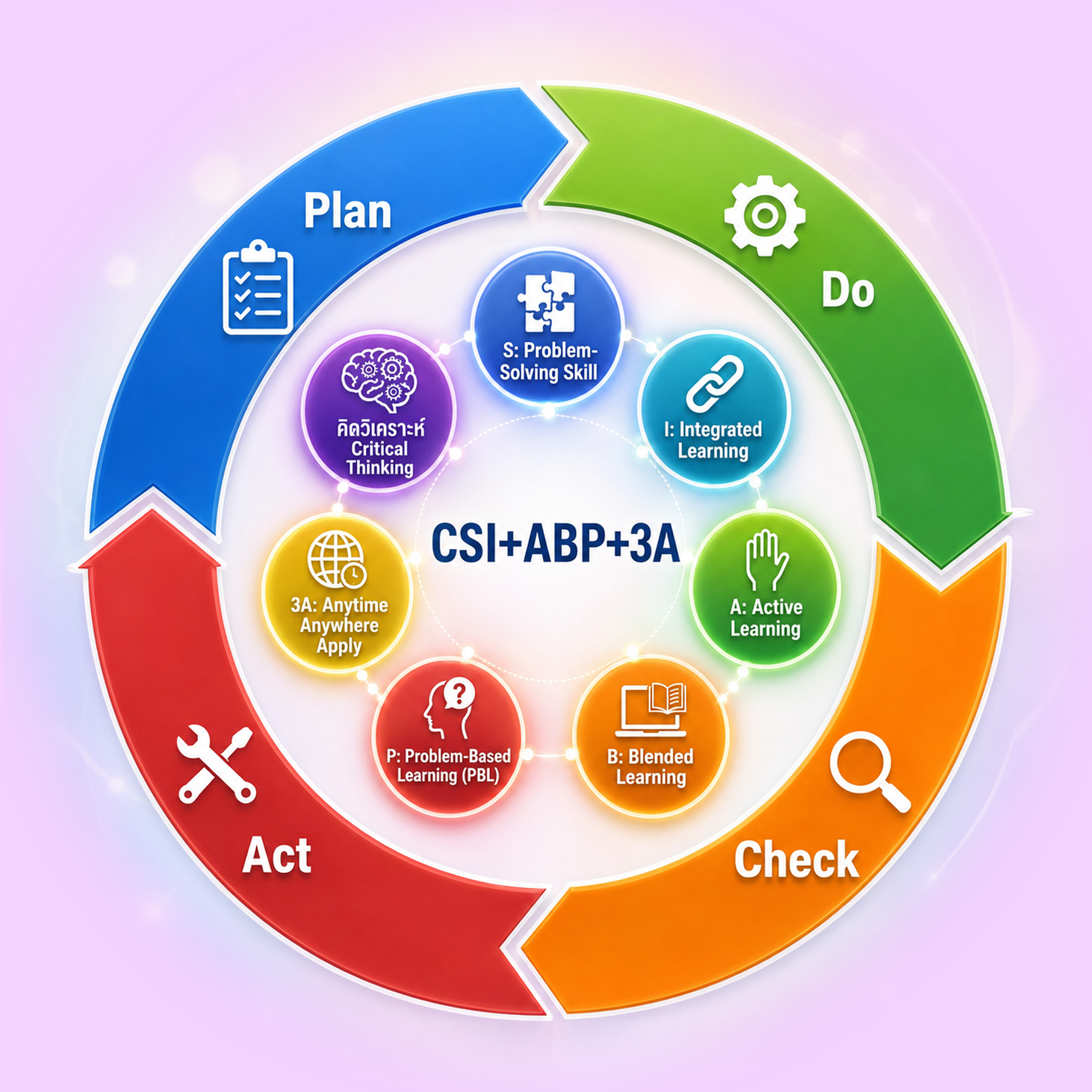
ส่วนที่ 1: แกนกลางการเรียนรู้ (CSI+ABP+3A)
คือกลยุทธ์การจัดประสบการณ์เรียนรู้ 7 มิติ ที่ออกแบบมาเพื่อนักเรียน ม.4 โดยเฉพาะ:
• C - Critical Thinking (การคิดวิเคราะห์): ปรับจากการคิดสร้างสรรค์ทั่วไป สู่การคิดวิเคราะห์อย่างเป็นเหตุเป็นผล ซึ่งเป็นรากฐานสำคัญของการเขียนโปรแกรม (Coding) การวิเคราะห์ข้อมูล (Data Analysis) และการรู้เท่าทันเทคโนโลยี
• S - Solving Problem Skill (ทักษะการแก้ปัญหา): มุ่งเน้นกระบวนการคิดเชิงคำนวณ (Computational Thinking) ให้นักเรียนสามารถแตกปัญหาใหญ่ให้เป็นปัญหาย่อย (Decomposition) และออกแบบอัลกอริทึมเพื่อแก้ปัญหาอย่างเป็นระบบ
• I - Integration Learning (การเรียนรู้แบบบูรณาการ): เชื่อมโยงศาสตร์วิทยากรคำนวณเข้ากับบริบทสังคมจริง เช่น การบูรณาการเทคโนโลยี AI เข้ากับประเด็นการต่อต้านการทุจริต เพื่อให้นักเรียนเห็นคุณค่าของการใช้เทคโนโลยีในทางที่ถูกต้อง
• A - Active Learning (การเรียนรู้เชิงรุกผ่าน GPAS 5 Steps): เปลี่ยนบทบาทครูเป็นโค้ช (Facilitator) และให้นักเรียนสร้างองค์ความรู้ด้วยตนเองผ่านขั้นตอน: รวบรวมข้อมูล, คิดวิเคราะห์, ลงมือทำ, สรุปความรู้, และสื่อสารนำเสนอ
• B - Blended Learning (การเรียนรู้แบบผสมผสาน): ผสานการทดลองปฏิบัติจริงในห้องปฏิบัติการคอมพิวเตอร์ (On-site) เข้ากับการเรียนรู้ออนไลน์ผ่านระบบ LMS (เช่น Moodle) เพื่อความยืดหยุ่น
• P - Problem-Based Learning - PBL (การเรียนรู้โดยใช้ปัญหาเป็นฐาน): ใช้สถานการณ์หรือโครงงานที่ท้าทายความสามารถเป็นตัวขับเคลื่อนการเรียนรู้ (Driver)
• 3A - Anytime • Anywhere • Apply: ทลายข้อจำกัดของเวลาและสถานที่ ผู้เรียนสามารถเข้าถึงแหล่งเรียนรู้ เขียนโค้ด ทบทวนบทเรียนได้ทุกที่ ทุกเวลา และสามารถ "ประยุกต์ใช้" ทักษะดิจิทัลในชีวิตประจำวันได้จริง
ส่วนที่ 2. วงจรการขับเคลื่อน (The PDCA Implementation Cycle)
เพื่อให้การใช้นวัตกรรม CSI+ABP+3A เกิดประสิทธิภาพสูงสุดและพร้อมสำหรับการเผยแพร่ทางวิชาการ จึงนำวงจร PDCA มาเป็นกรอบในการดำเนินการ:
1. Plan (การวางแผนกลยุทธ์):
• วิเคราะห์หลักสูตร มาตรฐานการเรียนรู้วิชาวิทยาการคำนวณ ม.4
• ออกแบบแผนการจัดการเรียนรู้ที่เน้นปัญหาเป็นฐาน (PBL)
• จัดเตรียมสถาปัตยกรรมเทคโนโลยี เช่น การเซ็ตอัพระบบ Moodle ออนไลน์
• สร้างเครื่องมือวัดผลและเกณฑ์การประเมิน (Rubrics) ที่ครอบคลุมทั้งทักษะ Hard Skill และ Soft Skill
2. Do (การปฏิบัติการสอน):
• ดำเนินการสอนตามรูปแบบ CSI+ABP+3A ในระยะเวลาที่กำหนด (เช่น 4-8 สัปดาห์)
• จัดกิจกรรมที่ท้าทายให้ผู้เรียนได้เขียนโปรแกรม (เช่น C++, JavaScript, HTML) หรือใช้เครื่องมือ AI สร้างสรรค์ผลงาน
3. Check (การตรวจสอบและประเมินผล):
• ประเมินผลสัมฤทธิ์ทางการเรียนจากการทดสอบ Pre-post test
• วิเคราะห์ร่องรอยการเรียนรู้จาก Log file ในระบบ Moodle
• ประเมินชิ้นงาน โครงงาน และพฤติกรรมการแก้ปัญหาของนักเรียน
4. Act (การปรับปรุงและการสะท้อนผล):
• นำข้อมูลเชิงประจักษ์มาวิเคราะห์ (Reflection)
• ปรับปรุงกระบวนการสอน พัฒนาสื่อให้มีประสิทธิภาพมากขึ้น หรือปรับแก้เกณฑ์ Rubric ให้สะท้อนสมรรถนะผู้เรียนได้แม่นยำขึ้น
• การเตรียมเผยแพร่ (Publication Readiness): สรุปผลลัพธ์ จัดทำรายงานวิจัยเชิงปฏิบัติการ (Action Research) และถอดบทเรียนเป็น Best Practice เพื่อเตรียมนำเสนอในเวทีวิชาการ
จุดเด่นของรูปแบบนี้สำหรับการตีพิมพ์ (Selling Points for Publication)
รูปแบบการสอนนี้มีความแข็งแกร่งทางวิชาการ เพราะไม่ได้จบแค่การสอนในห้องเรียน แต่แสดงให้เห็นถึง "ระบบ" ที่มีการวางแผน ลงมือทำ วัดผลด้วยสถิติเชิงประจักษ์ และเกิดการสะท้อนผลลัพธ์เพื่อพัฒนาต่อ (PDCA) ซึ่งเป็นสิ่งที่คณะกรรมการพิจารณาบทความวิจัย (Reviewers) ในงานประชุมวิชาการระดับชาติหรือนานาชาติ
3. ตัวอย่างบรรณานุกรมและลิงก์งานวิจัยที่เกี่ยวข้อง
- Al-Ani, W. T. (2013). Blended Learning Approach Using Moodle and Student's Achievement, Motivation, and Collaboration. International Journal of Emerging Technologies in Learning. URL: https://files.eric.ed.gov/fulltext/EJ1077202.pdf
- Arifin, M. (2020). The Effect of Blended Learning Model with Moodle on the Students' Writing Achievement. Universal Journal of Educational Research. URL: https://pdfs.semanticscholar.org/96f7/412b3bd15c61186945e4de5d635c7879de40.pdf
- Sun, L. (2014). Investigating the Effectiveness of Moodle-based Blended Learning. International Journal of Information Technology and Management. Abstract: https://www.inderscienceonline.com/doi/abs/10.1504/IJITM.2014.059152
- Oktavia, Y. (2025). The Role of Blended Learning and Creative Problem-Solving in Enhancing Students’ Scientific Writing Skills. TEM Journal, 14(2), 1445–1457. URL: https://www.temjournal.com/content/142/TEMJournalMay2025_1445_1457.pdf
- Susilowati, N. E. (2025). Problem-Based Blended Learning (PBBL) and Creative Thinking Skills. Al-Biruni Journal. URL: https://ejournal.radenintan.ac.id/index.php/al-biruni/article/download/26616/9335/84758
- Frontiers in Education (2022). Integrating Problem-Based Learning and Computational Thinking to Cultivate Creative Thinking. URL: https://www.frontiersin.org/articles/10.3389/feduc.2025.1625105/full
- Sophonhiranrak, S. (2015). Factors Affecting Creative Problem Solving in the Blended Learning Environment. Procedia - Social and Behavioral Sciences. URL: https://www.sciencedirect.com/science/article/pii/S1877042815013208
- Wola, J. (2025). The Development of Creative Problem Solving of Grade 10 Students through Blended and Inquiry-based Learning. Journal of Learning. URL: https://journal.gmpionline.com/index.php/jgl/article/download/605/419
- IPST (สสวท.). (2020). คู่มือครูวิทยาการคำนวณ ม.4 และตัวอย่างสื่อออนไลน์. - MyIPST: https://myipst.ipst.ac.th/baskets/Computer-M4 - Project14 CS M.4: https://proj14.ipst.ac.th/m4-6-cs/m4-cs/
- Khon Kaen University Repository. (2022). The Development of Learning Activity Based on Problem-Based Learning Cooperated with Web-based Learning to Improve Computational Thinking. URL: http://202.28.34.124/dspace/handle/123456789/1649